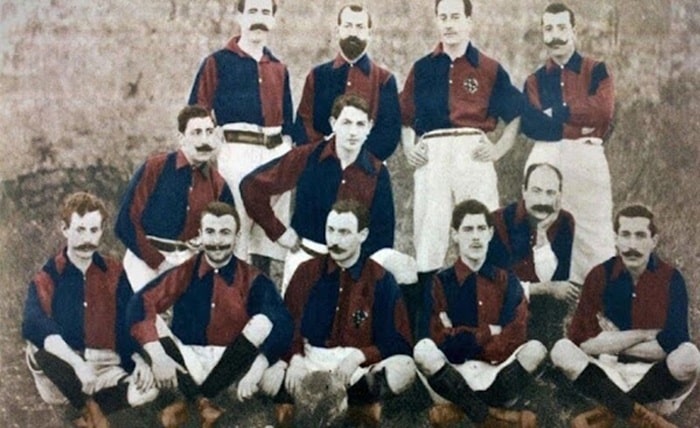
Lịch sử câu lạc bộ Barcelona is a journey spanning more than a century, associated with major titles, generations of legendary players, and a football philosophy with far-reaching influence. When xem bóng đá trực tuyến with Xoilac TV, fans can easily recognize the distinctive values that the Catalan club has maintained throughout different eras.
Barcelona’s Founding and Early Development
Barcelona was founded on November 29, 1899, by Joan Gamper and a group of players from various countries. From its early years, the club quickly became an important part of sporting life in Catalonia. More than simply a football team, Barca gradually developed into a symbol closely associated with the region’s culture and identity.
In lịch sử câu lạc bộ Barcelona, Joan Gamper played a particularly important role. He not only participated in founding the team but also served as president on several occasions, helping establish its organizational foundations and expand the club’s influence. Barcelona soon participated in local competitions before gradually establishing its position within the Spanish football system.
According to content that fans often explore on Xoilac 86, the early 20th century saw Barca win its first titles in the Copa del Rey and Catalan competitions. These achievements laid the foundation for the club to develop into one of the biggest forces in Spanish football.
Milestones That Shaped Barcelona’s Position
Barca’s development did not follow a straight path but went through many periods of ups and downs. From its early years of building solid foundations to the modern football era, each generation has left its own mark on the team.
Camp Nou and the Club’s Transformation
The rapid growth in the number of supporters meant that the Les Corts stadium gradually became unable to meet Barcelona’s needs. In 1957, Camp Nou was officially opened and quickly became one of the world’s most famous stadiums.
Camp Nou was not only a venue for matches but was also associated with many important moments in lịch sử câu lạc bộ Barcelona. Over the decades, the stadium has witnessed the emergence of numerous legends, intense El Clasico encounters, and memorable title races.
For those who regularly follow kết quả bóng đá hôm nay, Barcelona has always been one of the names attracting significant attention in La Liga. The team’s home matches during many periods have created a special appeal thanks to its attacking and technically sophisticated style of play.
Johan Cruyff Laid the Foundation for the Football Philosophy
Johan Cruyff was a figure who had a profound influence on Barcelona both as a player and as a coach. During his playing career at Barca in the 1970s, he introduced a modern approach to football that emphasized possession and intelligent movement.
His greater influence emerged when Cruyff became the manager. He built the famous Dream Team, using an approach based on possession, team spacing, and positional rotations. This is considered one of the most important turning points in lịch sử câu lạc bộ Barcelona.
Under Cruyff, Barcelona won several domestic championships and, most notably, the European Cup in 1992. This success was significant not only because of the trophy itself but also because it created a footballing philosophy that influenced many generations to come.
The Dream Team Opens a New Era of Success
The Dream Team of the early 1990s featured outstanding players such as Ronald Koeman, Pep Guardiola, Michael Laudrup, and Hristo Stoichkov. Barca at the time combined exceptional individual quality with a clearly defined tactical system.
According to football content updated on Xoi Lac TV, the 1992 European title at Wembley was particularly significant because it marked the first time Barcelona had reached the summit of Europe’s most prestigious club competition. Ronald Koeman’s goal against Sampdoria became one of the most memorable moments in the club’s history.
This period helped Barcelona establish foundations in youth development, tactics, and possession-based football. These elements were later developed further, particularly when Pep Guardiola became first-team manager.
La Masia Creates a Distinctive Identity
An important part of Barca’s success has come from the La Masia academy. Rather than relying solely on expensive transfers, the club has focused on developing players from a young age according to the same footballing philosophy.
La Masia has produced many great names, including Xavi Hernandez, Andres Iniesta, Carles Puyol, Sergio Busquets, and Lionel Messi. Having many players develop within the same system allows the team to coordinate naturally, understand their positions clearly, and maintain a consistent playing style.
The Ronaldinho and Messi Era and Guardiola’s Peak
In the early 2000s, Barcelona underwent a major rebuilding process. The arrival of Ronaldinho brought a new source of inspiration to the team. With his technique, creativity, and expressive playing style, the Brazilian star helped Barca regain its position in Spain and Europe.
The 2006 Champions League title was a memorable milestone, but an even greater peak came when Pep Guardiola took charge of the first team in 2008. He developed ideas that had previously been established by Cruyff, combining possession with pressing and a very high tempo of ball circulation.
Barcelona had a core consisting of Messi, Xavi, Iniesta, Busquets, Puyol, Dani Alves, and Gerard Pique. This was one of the most outstanding generations in lịch sử câu lạc bộ Barcelona, producing a style of football that forced opponents to constantly move while making it extremely difficult for them to regain possession.
In the 2008/09 season, Barca won La Liga, the Copa del Rey, and the Champions League to complete the treble. In 2009, the team added three more trophies to complete the remarkable achievement of winning six titles in a single year.
Fans following Xôi Lạc TV often mention Guardiola’s Barcelona as a defining example of possession-based football. The team not only won matches but also left a major tactical influence on many clubs and coaches that followed.
Lionel Messi and the Era of an Icon
If Cruyff helped shape the philosophy, Lionel Messi became the most prominent player of Barcelona’s modern successful era. Joining the club’s youth system at a young age, Messi gradually developed from a promising youngster into a world-class star.
In a Barca shirt, he scored hundreds of goals and contributed to numerous La Liga, Copa del Rey, and Champions League titles. His dribbling, playmaking, finishing, and ability to link up with teammates made Messi the central figure in many different tactical systems.
Messi was not the only standout figure during this era. It also witnessed several memorable attacking trios. Messi, Samuel Eto’o, and Thierry Henry formed a formidable attacking force in the 2008/09 season, while Messi, Luis Suarez, and Neymar later formed the famous MSN trio.
In the 2014/15 season, Barcelona under Luis Enrique continued its success by winning the treble. This demonstrated that the club’s strength was not limited to Guardiola’s era but could also be maintained through new tactical approaches.
Barcelona During a Period of Transition
The departure of several key players forced Barca into a major period of change. Xavi, Iniesta, Neymar, and then Lionel Messi left the team one after another, forcing the club to build a new generation. This was also a period when Barcelona faced significant challenges in terms of both results and squad restructuring.
However, the tradition of using young players continued to provide positive signs. Talents developed through the academy gave Barca a foundation for rebuilding while maintaining its identity.
When xem bóng đá trực tuyến, fans can see that despite changes in personnel and tactical approaches, Barca has often continued to prioritize possession, building from the back, and developing technically gifted players. These are precisely the elements that have been cultivated across many generations.
On Xoilac Tivi, Barcelona matches also tend to attract significant attention because each transitional period brings new young players into the spotlight. In addition to the scoreline, viewers can also follow kết quả bóng đá hôm nay to assess the team’s form in each competition.
The Values That Define Barcelona’s Identity
What makes Barcelona special is that the club’s history is closely connected to a relatively clear footballing philosophy. From Cruyff to Guardiola and the generations that followed, controlling space, short passing, and proactively dictating the game have always been emphasized.
The motto “Més que un club,” meaning “More than a club,” also reflects Barca’s special position in Catalan cultural life. Therefore, the team’s success is measured not only by the number of trophies but also by its ability to preserve its identity, develop players, and influence football around the world.
Over more than a century, lịch sử câu lạc bộ Barcelona has gone through glorious periods alongside difficult stages. However, its ability to evolve while retaining many fundamental values has helped Barca maintain a special place in the hearts of football fans.
Conclusion
Lịch sử câu lạc bộ Barcelona is a story of more than a century of building an identity, from Joan Gamper and Johan Cruyff to the glorious years of Messi and Guardiola. Alongside Xôi Lạc Link, fans can continue exploring the stories, personalities, and memorable milestones of one of the most historic clubs in world football.